Who Am I?
I am flowing,
I am falling,
Sometimes lying, sitting, or standing.
When you see me standing, sitting, or lying,
Do not forget that it is just a temporary form full of movement within.
If you think of me as static or non-living,
Then you live in oblivion and dark.
A surprise in the form of a lesson comes in your direction soon.
When asleep in the dark, I move and suddenly hit very hard.
For movement within me transforms into flow and fall again.
One can never grasp me and hold on to me without letting go.
I always move,
I always change.
Who am I?
I am water. I am human. I am time, energy, life itself, nature, the earth, the universe.
I am all, and I am one.
There in the bowl, I am the tea.
I am you, and I am me.
— Josef Beran
Afterword: Embracing the Fluidity of Existence
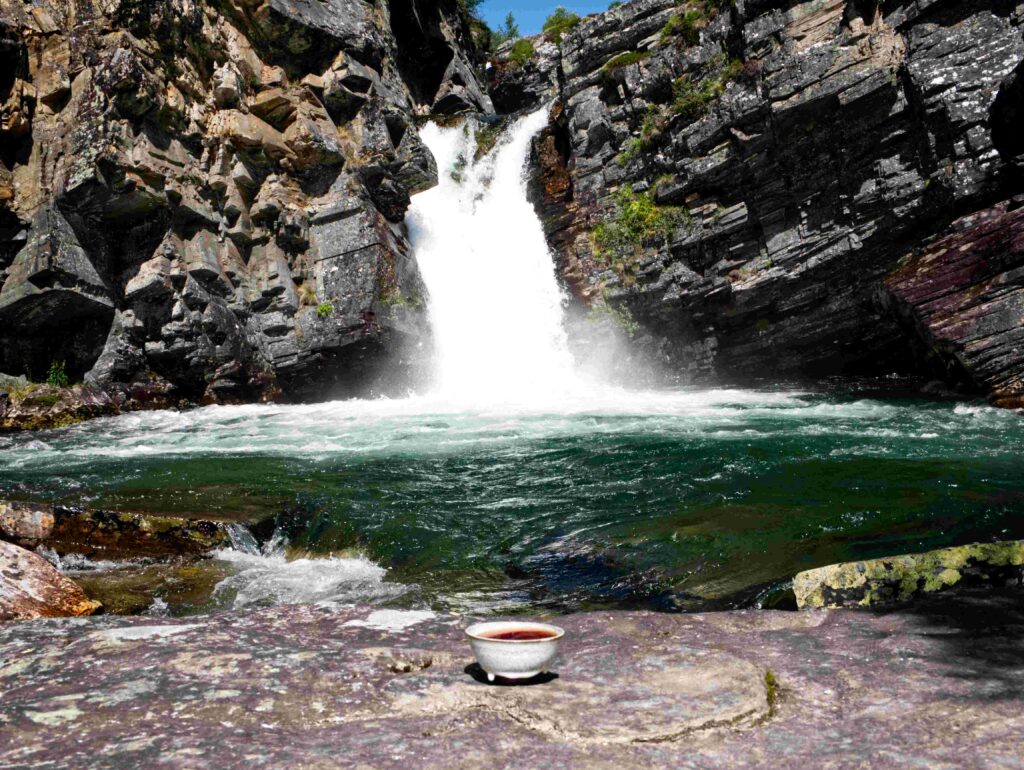
I wrote this poem in the summer of 2021 while sitting in silent meditation in front of the waterfall you see in the photo. The sound of the falling water blended with the rhythm of my own inner stillness—a stillness that had slowly emerged from the depths of personal loss and grief. In that quiet presence, something wordless stirred within me—something I had long carried and was only beginning to understand. This moment held not only the presence of now, but also echoes of my story, the journey through suffering that brought me there. The tea bowl you see in the image became more than a simple object—it became a vessel for awareness. The poem flowed from that moment, like water itself: ungraspable, yet full of meaning.
This poem is an invitation. It invites you to remember the ever-changing nature of life and to see yourself not as something fixed or finished, but as something alive, in motion. Through the metaphor of water, it speaks to a truth that often slips through our fingers: everything flows, and we are part of that flow. We live in a world that often teaches us to see ourselves and life through a static lens. We cling to identities, roles, expectations. But this rigidity can lead to suffering. When we try to hold on to what must move, we create tension. And when we forget the flow within and around us, we fall into what the poem calls “oblivion and dark.” In mindfulness and in Buddhist teachings, this insight is known as anicca—impermanence. Everything changes. To resist this is to suffer; to accept it is to awaken.
As the poem says:
“One can never grasp me and hold on to me without letting go.”
This speaks to the heart of non-attachment—not as detachment or apathy, but as an open-handed way of living. Letting go does not mean not loving; it means loving fully while knowing everything is passing through. The final lines remind us of our deep interconnectedness:
“I am water. I am human. I am time, energy, life itself, nature, the earth, the universe.
There in the bowl, I am the tea.
I am you, and I am me.” When we see clearly, we realize we are not separate from anything. Not from nature. Not from time. Not even from each other.
This poem—and the moment it came from—serves as a reminder to live like water: to flow, to adapt, to reflect, and to return again and again to presence. May you find in these words a gentle mirror.
May they inspire you to live more fluidly, more openly.
To meet each moment not with resistance, but with awareness.
And to recognize, in every breath and every drop, the universe alive within you.